Raw Ground Beef Temperature and Safety
Footing Beefiness: the Most Popular Meat Ground beef patties are the nigh popular beef item for The states consumers; nearly 12 billion hamburgers were consumed by Americans in 2007 (3). Basis beef patties are the most oft grilled meat (1). Basis beef is likewise popular in other forms such equally meat loaf, meat balls, sloppy joes, and tacos.  How To Handle and Cook Ground Beefiness As explained below (come across Why is Raw Ground Beef Singled Out by Food Safe Experts?), the unique character of ground beef warrants conscientious treatment. Avert Contaminating Other Foods with Raw Meat or Raw Meat Juice
Apply a Thermometer to Insure Footing Beef Reaches the Safely Cooked Internal Temperature of 160°F 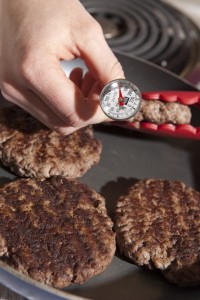 Devastation of the pathogens that may be present in raw footing beef, particularly East. coli, requires a cooking procedure that heats the beef to an internal temperature of 160°F (twenty). Use of a nutrient thermometer is the simply style to determine that the internal temperature of ground beef patties has reached 160°F (xiii, 19). (Unfortunately, only 13% of consumers ever or often use a thermometer when cooking or grilling hamburgers (9).) Learn how to apply a nutrient thermometers when cooking basis beef: The Academy of Idaho Extension website, "All About Food Thermometers" provides information about cooking with nutrient thermometers, including data about how to choose a nutrient thermometer and how to utilize one.
 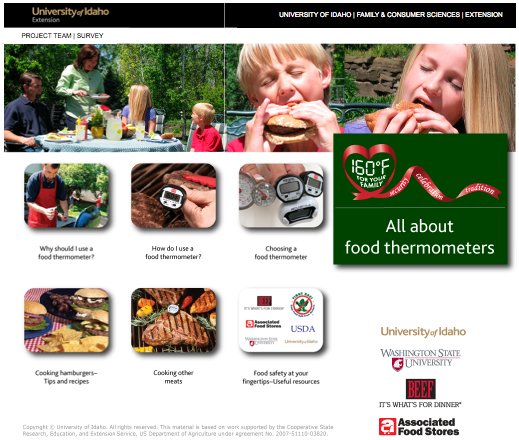 The USDA'due south Nutrient Safety and Inspection Service Thermometers and Food Safety page also provides data about thermometers and how to use them.
  Basis beef patties should be tested for the safely cooked temperature of 160°F in several locations because the unabridged patty does non attain one temperature at the same time. Additionally, the lowest temperature is not always in the center of the patty (16). Why is Raw Ground Beef Singled Out by Food Safe Experts?
  Although other meats accept caused foodborne illness, there are several attributes of basis beef which advise that more conscientious handling–particularly use of a thermometer to melt to 160°F– is required. Ground Beef May Contain Pathogens Throughout Retail basis beef may contain pathogens (affliction-causing microorganisms), most notably Escherichia coli O157:H7 and Salmonella enterica. These pathogens are ofttimes associated with food animals, and Eastward. coli O157:H7 is particularly associated with ruminant animals.
 Illnesses Have Been Associated with Ground Beef Consumers accept adult E. coli O157:H7 infections from consumption of undercooked ground beefiness.
Previous Communication to Consumers to Use Cooked Meat Color as an Indicator of Safe Ground Beef was Wrong Prior to 1997, consumers were encouraged to cook ground beef until "brown" in the centre to clinch a safe temperature had been reached (11). Withal, research conducted in the 1990s determined that cooked ground beef color does not correlate to safe endpoint temperature (2, six, seven, eleven). Ground beef tin plough brown before it reaches 160°F or information technology may retain a pinkish color at temperatures to a higher place 160°F–cooked color change in ground beef depends on a number of factors, including pH, meat source, packaging, freezing history and added ingredients (8).
These photos illustrate the color-temperature disconnect for basis beef patties: 

The only manner to decide that basis beefiness patties, or other products formed from basis beefiness, such as meat loaf or large meat assurance, are safely cooked is to employ a thermometer to determine the safe temperature of 160°F has been reached. (Normal cooking practice for minor ground beef products such as crumbles means they are by and large cooked to well above 160°F.)
Labels on Packages of Frozen Ground Beef Patties Do Not Ever Provide Cooking Instructions That Result in Safely Cooked Patties
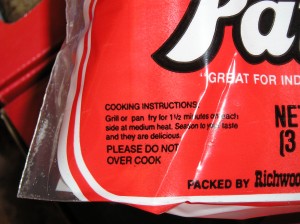
A recent survey of labels on packages of frozen basis beef patties (four oz. size) revealed some packages propose cooking times of i.five to ii min/side. Inquiry on consumer cooking procedures indicates that cooking times of less than 3 min/side could not produce a safely cooked production, thus some packages provided dangerous instructions. Frozen ground beefiness patties generally required vii to nine min total cooking time and starting with a room temperature pan (not preheated) extends the cooking time by about iv min. Furthermore, cook times on a propane grill are more variable in than a fry pan on the electric stove. Bottom line: The variability of cooking times for patties makes it Packaging also gave conflicting information about the use of cooked color to predict doneness and about avoiding both overcooking and undercooking, provided an assortment of disruptive instructions for consumers (12).

Since 1994, federal regulations require a Rubber Handling Label, which includes information about storing, cooking, and fugitive cross contamination, on all consumer packages of basis beef (and other raw meat) (14).
Conclusion
Until ground beefiness is bodacious to be a pathogen-free product, consumers tin all-time protect themselves and their loved ones past using a food thermometer to make sure cooked ground beef reaches a safe temperature of 160°F.
References
i. American Meat Establish. 2007. Grills to Sizzle Over Holiday Weekend, May 26. http://www.meatami.com/ht/d/ReleaseDetails/i/3023.
2. Berry, B. Due west. and M.E. Bigner-George. 2000. Factors affecting color properties of beefiness patties cooked on an outdoor gas grill. J. Musculus Foods 11:213-226.
3. Cattleman'due south Beefiness Board. 2008. "I'll have a burger with a side of burger," CBB Checkoff News, http://www.beefboard.org. Accessed July 11, 2008.
four. Davis, M. plus 34 others. 1993. Update: Multistate outbreak of Escherichia coli O157:H7 infections from hamburgers — Western United States, 1992-1993, Morb. Mort. Weekly Rep. 42(14):258-263.
5. DeWaal, C. S. and F. Bhuiya. 2007. Outbreak Alert! Center for Science in the Public Interest, page 12, http://www.cspinet.org/foodsafety/outbreak_alert.pdf.
6. Hague, M.A.; K.Eastward. Warren; M.C. Hunt; D.H. Kropf; C.50. Kastner; S.50. Stroda; and D.Eastward. Johnson. 1994. Endpoint temperature, internal cooked colour, and expressible juice color relationships in basis beef patties. J. Food Sci. 59(3): 465-470.
7. Killinger, K.M., M.C. Hunt, R.E. Campbell and D.H. Kropf. 2000. Factors affecting premature browning during cooking of store-purchased ground beefiness. J. Food Sci. 65(4):585-587.
8. King, N.J. and Whyte, R. 2006. "Does It Look Cooked? A Review of Factors that Influence Cooked Meat Color," J. Food Sci. 71(4):R31-R40.
9. Lando, A. and 50. Verrill. 2008. 2006 FDA/FSIS Food Safety Survey, http://www.fda.gov/Food/ScienceResearch/ResearchAreas/ConsumerResearch/ucm080374.htm.
10. Lange, L. 2008. Beef trim baseline results and how FSIS volition use, Presentation at Eastward. coli Public Coming together, April nine, Washington, D.C., http://world wide web.fsis.usda.gov/PPT/Beef_Trim_Baseline_040908.ppt. Accessed Oct 8, 2008.
eleven. Lyon, B. G., B. W. Drupe, D. Soderberg, and Northward. Assure. 2000. Visual color and doneness indicators and the incidence of premature chocolate-brown colour in beef patties cooked to four end point temperatures. J. Food Prot. 63(10):1389-1398.
12. McCurdy, S.M., M.T. Takeuchi, Z. Edwards, Thousand. Edlefsen, D-H. Kang, V.East. Mayes, and 5. N. Hillers. 2006. Nutrient rubber education initiative to increment consumer use of food thermometers in the United States. Br. Food J. 108:775-794.
13. McCurdy, S.M., Finley, K., and Zemmer, T. 2009. Label instructions and cooking times for retail frozen ground beef patties. Food Prot. Trends 29(6):335-341.
14. Ralston, K. L. and Lin, C. T. J. 2001. U.S. Safe Handling Labels for Meat and Poultry: A Case Written report in Information Policy. Consumer Interests Almanac, Volume 47.
xv. Rangel, J.M., P.H. Sparling, C. Crowe, P.M. Griffin, and D.50. Swerdlow. 2005. Epidemiology of Escherichia coli O157:H7 outbreaks, The states, 1982-2002. Emerging Infect. Dis. 11(4):603-609.
xvi. Rhee, Chiliad.South., S.Y. Lee, V.N. Hillers, Due south.M. McCurdy, and D-H. Kang. 2003. Evaluation of consumer -style cooking methods for reduction of Escherichia coli O157:H7 in ground beef. J Food Prot. 66:1030-1034.
17. Shillamplus, P. plus 12 others. 2002. Multistate outbreak of Escherichia coli O157:H7 infections associated with eating ground beefiness — U.s., June–July 2002, Morb. Mortal. Weekly Rep. 51(29):637-639.
eighteen. Slutsker, L., A.A. Ries, K. Maloney, J.Thou. Wells, K.D. Greene, and P.K. Griffin. 1998. A nationwide case-control study of Escherichia coli O157:H7 infection in the United States, J. Infect. Dis. 177:962-966.
19. U.S. Section of Agriculture, Nutrient Safety and Inspection Service. 2008a. Nutrient Safety Education: Thermy™, http://www.fsis.usda.gov/food_safety_education/thermy/alphabetize.asp, accessed June 30, 2008. http://www.fsis.usda.gov/News_&_Events/R01-2008_release/alphabetize.asp, accessed June xxx, 2008.
20. U.S. Department of Agriculture, Food Safety and Inspection Service. 2003a. Colour of cooked basis beef equally information technology relates to doneness, http://www.fsis.usda.gov/FactSheets/Color_of_Cooked_Ground_Beef/index.asp.
21. U.South. Department of Agronomics, Food Safe and Inspection Service. 2002. Backgrounder: New measures to address E. coli O157:H7 contagion. http://www.fsis.usda.gov/OA/background/ec0902.pdf, accessed June thirty, 2008.
macdonaldhatat1938.blogspot.com
Source: https://www.foodsafetynews.com/2009/08/ground-beef-the-importance-of-safe-handling-practices-and-accurate-final-product-temperature/
0 Response to "Raw Ground Beef Temperature and Safety"
Enviar um comentário